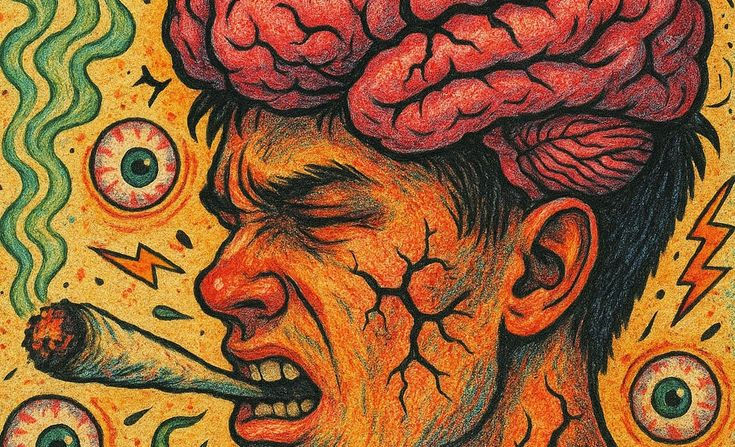
Cannabis-Induced Anxiety & Panic Attacks: Understanding the Connection

In recent years, as conversations around cannabis (often called “gãnja”, “weed”, “bhang” etc.) have become more prominent — whether for recreational, medicinal, or social use — it’s important to understand that cannabis does not affect everyone the same way. While some users report relaxation or relief, others experience intense anxiety, panic attacks, or even long-lasting psychological distress. At Collective Care Center, Pune, we believe in informed awareness: knowing both the possible benefits and risks is essential to safe, collective well-being.
What science says: Cannabis and anxiety/panic — a complex link
The psychoactive compound in cannabis responsible for “getting high” — Delta‑9 Tetrahydrocannabinol (THC) — is commonly associated with anxiogenic (anxiety-producing) effects.
There is evidence that cannabis use can increase the likelihood of panic attacks or panic disorder over time. For example, a longitudinal study found that cannabis use and dependence significantly predicted development of panic attacks or panic disorder in a sample followed from adolescence into young adulthood.
On the other hand, not everyone responds the same: some components of cannabis — notably Cannabidiol (CBD) — are reported to have anxiolytic (anxiety-reducing) potential.
The net effect seems to depend strongly on which cannabinoids are present (THC vs CBD), the dosage, method of use (smoking vs edibles), and the user’s mental state / vulnerability.
Why does cannabis sometimes trigger panic or anxiety? What happens in the body
THC interacts with cannabinoid receptors in brain regions that regulate mood, emotion, and physiological arousal (heart rate, blood pressure, perception). This interaction can cause elevated heart rate, altered perception, heightened emotional sensitivity — all of which may contribute to panic or anxiety in susceptible individuals.
Physiological changes like increased heart rate, changes in blood pressure etc., combined with psychoactive effects (altered time perception, sensory intensification, changes in cognition) can be interpreted by the mind as threatening — triggering a “panic response.”
For some individuals, even a single exposure (especially in unfamiliar or stressful settings) can unmask or precipitate a panic attack; in others, repeated or long-term use might lead to more recurrent anxiety or panic episodes.
Who is more at risk? Vulnerable factors
Based on existing research, risk of cannabis-induced anxiety or panic may be higher when:
The cannabis consumed is high in THC, or has a poor balance of THC:CBD.
The user is inexperienced or uses cannabis in a stressful, unfamiliar, or socially uncomfortable environment (for example, among strangers).
There is a pre-existing mental health vulnerability or history (like anxiety, depression, past panic episodes), which may make someone more prone to panic when exposed to cannabis.
Use includes edibles or ingestible forms, which can have delayed onset and unpredictable effects, sometimes increasing risk of overconsumption or anxiety reactions.
But: the picture isn’t black-and-white
Some research suggests that the link between cannabis use (or even cannabis use disorder) and long-term anxiety disorders is not definitive — the data are often heterogeneous and inconsistent.
The association seen between cannabis use and anxiety may partly reflect a phenomenon where individuals with anxiety or stress are more likely to use cannabis as a form of self-medication rather than cannabis causing anxiety first.
There is ongoing debate and need for more research to clearly establish causal pathways.
What it means: For users, loved ones, and mental-health support providers
Cannabis use — especially recreational and unsupervised — is not “harmless.” People, especially those trying it for first time or with mental-health vulnerabilities, should be informed of potential adverse effects including panic and anxiety.
Perception matters a lot. A “bad trip” or panic when high isn’t simply “all in the mind” — it’s a real interaction of brain chemistry, body responses, and personal vulnerability.
For individuals experiencing cannabis-related anxiety or panic, support, careful evaluation, and possibly professional help may be needed (rather than ignoring or dismissing the reaction).
For mental-health and community support centers (like ours), there’s a need to create safe spaces for people to talk about their experiences — ideally without shame or judgment — and to provide education, counselling, and harm-reduction.
What we at Collective Care Center, Pune recommend
If you choose to use cannabis — be cautious: start with very low doses; avoid high-THC or unknown-quality products; avoid combining with alcohol or other substances.
Avoid consuming in high-stress, unfamiliar, or socially uncomfortable settings (especially for first-time or occasional users).
Be attentive to your mental state — if you have anxiety or past panic, reconsider using cannabis.
If you experience anxiety or panic — don’t ignore it. Consider seeking counselling or mental-health support.
Community awareness and open discussion: We encourage honest conversations (with friends, family, support groups) about the risks, rather than silence or stigma.
Closing thoughts
Cannabis is often discussed in polarized terms — “harmless fun,” or “dangerous drug.” The truth, as is common in mental-health and substance-use contexts, lies somewhere in between. For some, cannabis may bring relaxation or temporary escape; for others — especially those vulnerable — it may trigger profound anxiety or panic, with consequences that last far beyond the immediate “high.”
At Collective Care Center, Pune, we believe collective care means creating awareness, offering support without judgment, and helping individuals make informed, safe, and compassionate choices.